
Risk logic in Trustible is driven by Attributes, which create a stable “meaning layer” over intake answers.
How it works:
- Intake questions (especially multiple choice) have response options.
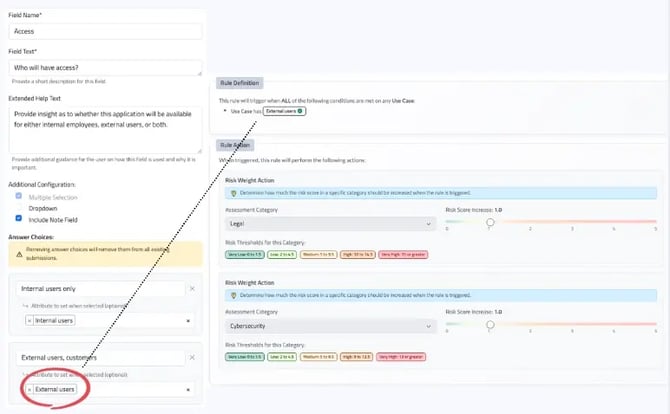
- Each response option can be tagged with one or more Attributes (e.g., “Sensitive PII”, “Third-party system”, “Generative AI”, “Internal users”).
- When a user selects a response, that Attribute is “activated” for the use case.
- Activated Attributes then trigger rules that can:
- influence risk category scoring (weights)
- recommend specific risks (where configured)
- trigger conditional questions or additional tasks (optional task groups)
- eventually trigger actions like notifications (roadmap direction mentioned)
Why this matters: your questions may evolve over time, but Attributes help keep your risk logic consistent by mapping to the theme of a response rather than the exact wording.
The 0-5 scale was determined per category based on the maximum number of points that could be associated with that category once the Risk Assessment is completed.
The Very Low category is reserved for scores of 2 points or less, and the remaining thresholds were set by creating equal-sized buckets from 2 to the maximum points.